Weekly Human Rights Press Briefing No. 19/2025 National Human Rights Commission of Thailand (NHRCT) 6 June 2025

06/06/2025 878

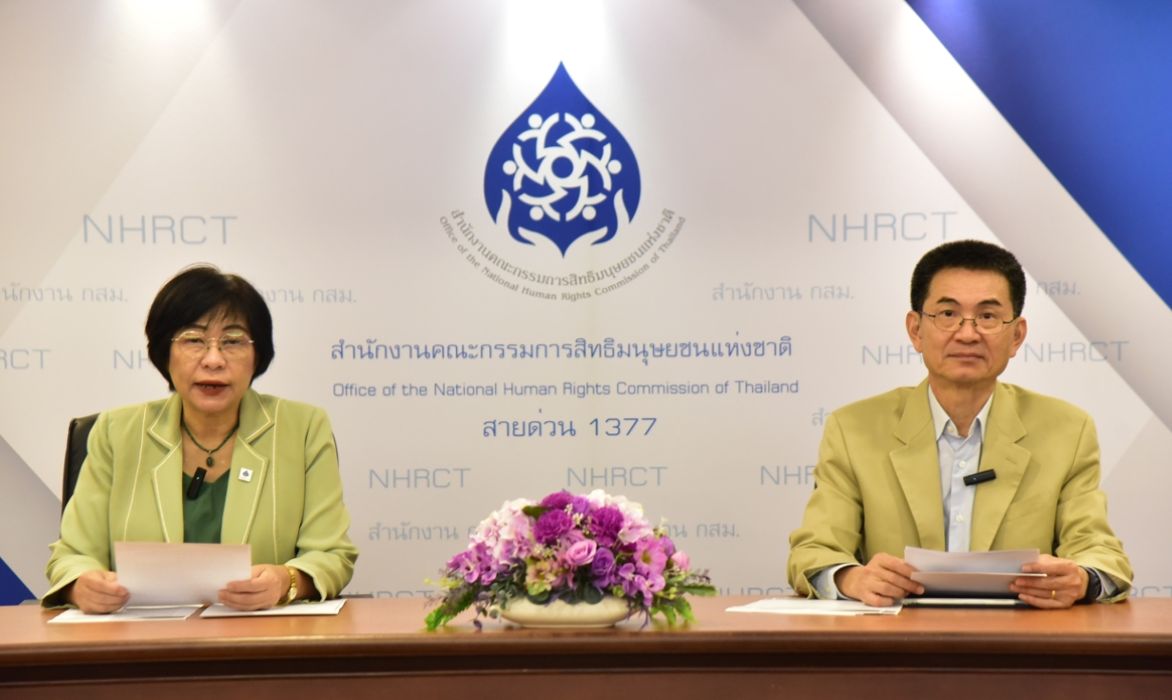
            The National Human Rights Commission of Thailand (NHRCT), represented by Mr. Wasan Paileeklee and Ms. Sayamol Kaiyoorawongs, held its 19th weekly press briefing on Friday, 6 June 2025, at 10:30 a.m. The briefing addressed the following key issues:

            1. Environmental pollution from a tire recycling factory in Khon Kaen; NHRCT recommends regulatory amendment and enhanced participatory public hearings.

            Mr. Wasan Paileeklee, NHRCT Commissione, stated that in July 2014, the NHRCT received a complaint from a community’s representative regarding environmental and public health impacts allegedly caused by a tire recycling factory in Khok Sung Sub-district, Ubolratana District, Khon Kaen Province. The factory, which commenced operations in February 2024, produces alternative fuels from used tires and plastics and, in doing so, allegedly generates air pollution, unpleasant odours, and wastewater, adversely affecting communities. Additionally, the public was neither informed nor included in the licensing process, which was overseen by the Khon Kaen Provincial Industrial Office and the Department of Industrial Works. The complainant alleged the permit was granted with undue haste and requested a thorough investigation.

            Following an assessment based on factual evidence, applicable legal frameworks, and human rights standards, the NHRCT identified three primary areas of concern. Firstly, public participation and access to information. Although the Factory Act B.E. 2535 (1992) and its subsequent amendments do not require public hearings during the licensing process, the NHRCT emphasized that affected communities must have access to relevant information and participate in the decision-making. A public hearing conducted in May 2022 with 79 participants from Moo 2 Village excluded residents of nearby villages, raising concerns about the legitimacy of the process. The Commission noted that, as the hearing was held prior to the submission of a license application and was not legally required, it may have contributed to confusion and a perceived violation of participatory rights.

            The second issue concerns whether the licensing process by the Khon Kaen Provincial Industrial Office and the Department of Industrial Works lacked public participation and was carried out too hastily. According to the Ministerial Regulation on Public Hearings under the Factory Act B.E. 2555 (2012) and its 2014 amendment, licensing authorities are required to post notices in designated locations but are not obligated to conduct meetings. In this case, the authorities complied with the regulation’s timeline and procedures. Therefore, it could not be concluded that they violated human rights by action or omission.

            The third issue involves environmental and community impacts. Investigations revealed that the factory had emitted excessive soot and black smoke, posing serious health and environmental hazards. These emissions constituted a public nuisance under the Public Health Act B.E. 2535 (1992) and qualified as pollution under the Environmental Quality Promotion and Conservation Act B.E. 2535 (1992).

            The factory generated significant soot and black smoke, both inside and outside the facility, causing air pollution beyond legal limits and affecting nearby residents’ health. This constituted a public nuisance under the Public Health Act B.E. 2535 (1992) and a pollution source under the Environmental Quality Promotion and Conservation Act B.E. 2535 (1992), posing serious threats to health, safety, and the environment.

            The NHRCT found that the Khon Kaen Provincial Industrial Office failed in its duty to strictly verify compliance before operations began. Their inspection report stated full compliance with all licensing conditions, which contradicted later findings by the Department of Industrial Works that confirmed pollution emissions. This failure to conduct thorough inspections before operations began resulted in violations of human rights. However, corrective actions were later undertaken by the Khok Sung Subdistrict Municipality and relevant government bodies, including a temporary suspension of the factory's operations by the Department of Industrial Works. The NHRCT acknowledged these responses as appropriate.

            For the afore-mentioned reasons, the NHRCT, at its meeting on 4 June 2025, resolved to recommend that the Rights and Liberties Protection Department and the Department of Industrial Works jointly encourage the tire recycling facility to adopt a comprehensive Human Rights Due Diligence (HRDD) approach in their business operations. This includes conducting public hearings in Moo 1, Moo 2, Moo 5, Moo 12, Moo 13, and other villages that may be affected, to clarify the factory’s activities, potential impacts, mitigation measures, and grievance mechanisms. Relevant agencies should be invited to participate in these hearings. Moreover, the company must comply with environmental standards issued by the Office of Environmental and Pollution Control Region 10 (Khon Kaen) to prevent future impacts and ensure worker safety.

            Additionally, the NHRCT recommended that the Ministry of Industry and the Department of Industrial Works revise the Ministerial Regulation on Public Hearings under the Factory Act to replace notice-posting with inclusive, in-person hearings and multi-channel public communication. The definition of affected stakeholders should be broadened to include all potentially impacted communities.

            The Department of Industrial Works should instruct all provincial industrial offices to strictly supervise staff who conduct initial inspections to ensure compliance with permit conditions. If non-compliance is found, corrective orders must be issued prior to the commencement of operations.

            2. Transboundary Water Pollution in Kok and Sai Rivers from Mining in Myanmar: NHRCT Urges Government Action and Regional Cooperation.

            Ms. Sayamol Kaiyoorawongs, Human Rights Commissioner, revealed that, On June 4, Chairperson of the NHRCT sent a letter to the Prime Minister regarding the situation of transboundary pollution in the Kok and Sai Rivers in Chiang Rai and Chiang Mai, which has severely impacted the health of people who use water from the river and for agriculture. This situation is caused by gold and rare-earth mining operations by unidentified foreign companies in Shan State, Myanmar. Toxic chemicals used in mining have contaminated water sources with heavy metals, including arsenic, cadmium, and mercury, thereby drastically degrading water quality.

            Chronic arsenic exposure, even in small amounts, can cause severe health effects, including skin diseases, peripheral nerve damage, vascular blockage, cancer, hypertension, heart disease, diabetes, memory loss, developmental delays in children, and pregnancy complications.

             The NHRCT concluded that this situation violates the rights to a clean, safe, and sustainable environment, and to an adequate standard of living—particularly food and water—under Article 11 of the International Covenant on Economic, Social and Cultural Rights (ICESCR), and the right to the highest attainable standard of health under Article 12. Contaminated water and food jeopardize public access to basic needs, deepen social inequality, particularly for vulnerable groups, and may provoke local conflicts over water usage. If left unresolved, this issue will raise household living costs, cause economic damage, and increase long-term public health and environmental recovery costs.

            Given the seriousness and risk of broader contamination, especially toward the Mekong River basin, the NHRCT proposed that the Cabinet assign relevant agencies to urgently implement the following recommendations:

            (1) Domestic Measures:

     (1.1) The Pollution Control Department should coordinate with other agencies to increase water and sediment sampling in high-risk areas, regularly publish test results and health risks in plain language, provide health guidance, and establish an efficient public warning system.

     (1.2) The Ministry of Public Health (via the Department of Disease Control, Department of Health, and Provincial Health Offices) should urgently provide free health screenings for heavy metal exposure (especially arsenic) and develop a long-term health database for monitoring.

     (1.3) The Provincial Waterworks Authority, local governments, and the Ministry of Interior should ensure emergency access to clean drinking water and plan for long-term safe water sourcing and efficient village water supply systems.

     (1.4) The Ministry of Agriculture and Cooperatives, the Ministry of Tourism and Sports, and relevant agencies should assess preliminary impacts on agriculture and tourism, provide immediate relief to affected persons, and support occupational recovery.

     (1.5) Funding should be allocated for removing toxins and rehabilitating contaminated water sources, as well as for restoring headwaters forest, wetlands, and riverbanks to support ecological balance.

     (1.6) The Upper Mekong River Basin Committee should act as the lead coordinating body. The National Water Resources Committee (NWRC) should appoint or revised the composition of provincial water sub-committees in Chiang Rai and Chiang Mai to include representatives from civil society, academia, and relevant government agencies in balanced proportions. These sub-committees should develop provincial action plans which involve community participation, based on water governance principles, and collaborate with the agencies listed in points (1.1)–(1.5).

            (2) International Measures:

      The Ministry of Foreign Affairs, along with relevant agencies such as the Ministry of Defence, the Ministry of Natural Resources and Environment, and the National Water Resources Office, should urgently engage in diplomatic negotiations with the country of origin to halt the mining operations that are causing pollution. Existing bilateral and regional cooperation mechanisms should be leveraged to pressure parent companies to assume responsibility, restore affected areas, and compensate victims in accordance with the UN Guiding Principles on Business and Human Rights (UNGPs).

      The Ministry of Foreign Affairs and relevant agencies should also promote regional collaboration frameworks to address transboundary pollution and encourage neighbouring countries to develop domestic legislation for the prevention, mitigation, and redress of such impacts.

Office of the National Human Rights Commission of Thailand

6 June 2025

Related Document Files
Scroll to top